From Intern to Impact: My Journey at Enterpret

A lot of internships start the same way. You get a laptop, a stack of onboarding docs, and some time to find your footing before you touch the codebase. There’s a lot to learn, so that makes sense.
My first few weeks at Enterpret looked a little different.
As an engineering intern, I got to contribute to production code from day one. I wasn’t just working on features used by real customers. I had the opportunity to take ownership of them from the initial idea through delivery and continue improving them afterwards. That responsibility helped me learn faster and contribute to meaningful projects.
I started by experimenting with speech models and helping build the infrastructure to run them. Later, I worked on improving a pipeline that helps teams spot emerging issues in customer feedback.
Somewhere along the way, “intern” became “full-time engineer.”
I didn’t get there alone. I was surrounded by people who knew a lot and never made me feel small for asking questions.
This is the story of the work, the people, and what I learned along the way.
Turning customer conversations into text
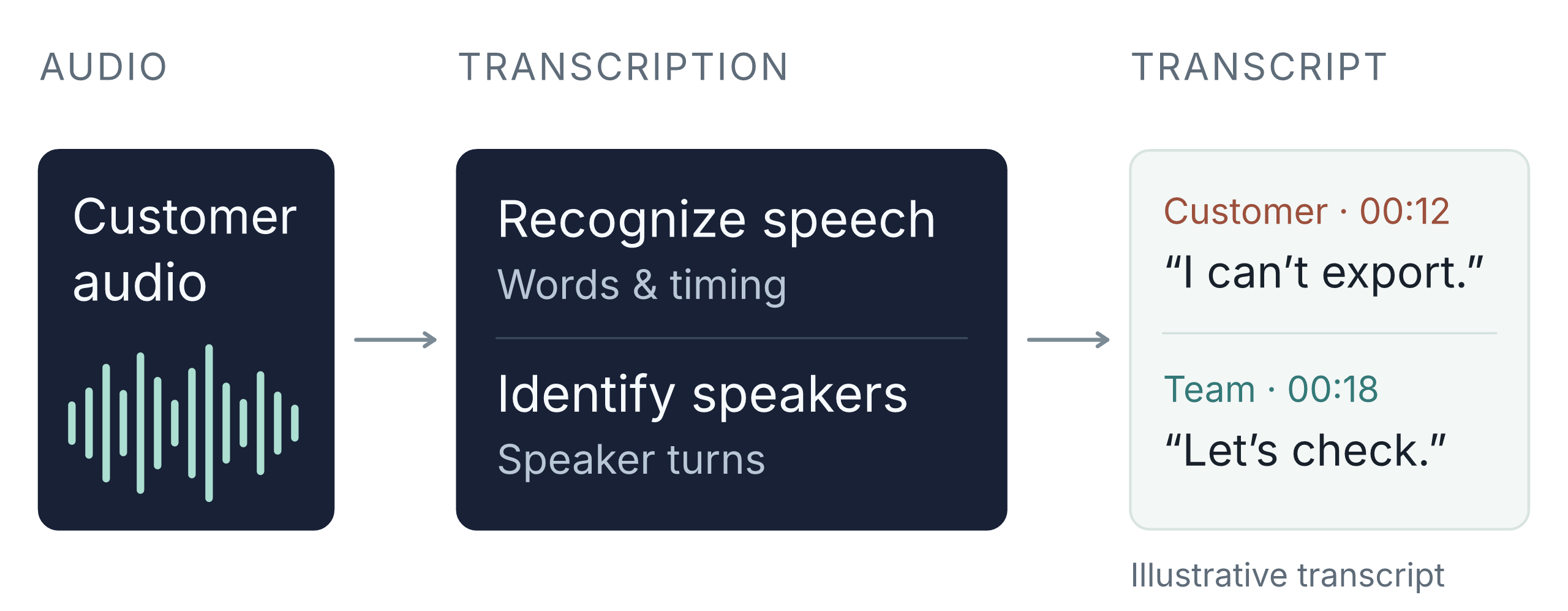
Customer feedback doesn’t always arrive as text. It also comes from recorded conversations, which need to be transcribed before people and models can use them alongside support tickets, reviews, and other feedback.
I worked on an internal transcription pipeline to make that possible. The project took us from evaluating speech models to building a platform that could process audio reliably. It was a new problem for me, and I was given the space to explore approaches and help shape the solution.
I didn’t start the project knowing how to evaluate speech models or reason about GPU workloads. I learned by reading, experimenting, and discussing results with the team. Having the responsibility to drive that exploration pushed me to understand the reasoning behind our decisions.
Starting with questions
My first challenge was figuring out how to tell whether a transcription was good enough. I learned to evaluate the text using metrics such as word error rate and METEOR, while also checking whether speech was attributed to the right speaker. Looking beyond a single score helped me understand where mistakes happened and how they could affect the conversation.
We built a dataset as a baseline for our experiments. Comparing results on the same recordings helped me understand whether a change improved the output and gave us a basis for deciding what to try next.
Accuracy wasn’t the only concern. We also needed to process audio efficiently, so I explored different hardware and ways of running the models. Looking at speed and throughput alongside quality helped me understand the trade-offs involved in choosing an approach for a real service.
From experiments to production
Once we had an approach to work with, the next challenge was making it reliable in production. We needed a service that could handle different workloads, run across multiple GPUs, and fit into the existing product.
I worked on testing the platform under load and understanding how much work it could handle. I also helped prepare the service to receive traffic, including thinking through when workers were ready and how the system should respond when it reached capacity.
I had read about workers, scaling, and reliability in system design discussions, but this was my chance to see those ideas in practice. With guidance from the team, I learned how to apply them to a real workload and grew more confident taking responsibility for the platform.
Following the project from research to production taught me that ownership means more than writing code. It means understanding the problem, asking questions, and using what you learn to make decisions as the work moves forward.
Helping teams act on customer feedback with Quality Monitor
When a product issue starts affecting customers, the first signs can be scattered across support tickets, reviews, calls, and other feedback. Each report tells part of the story, so it can take time for a team to recognize the larger issue.
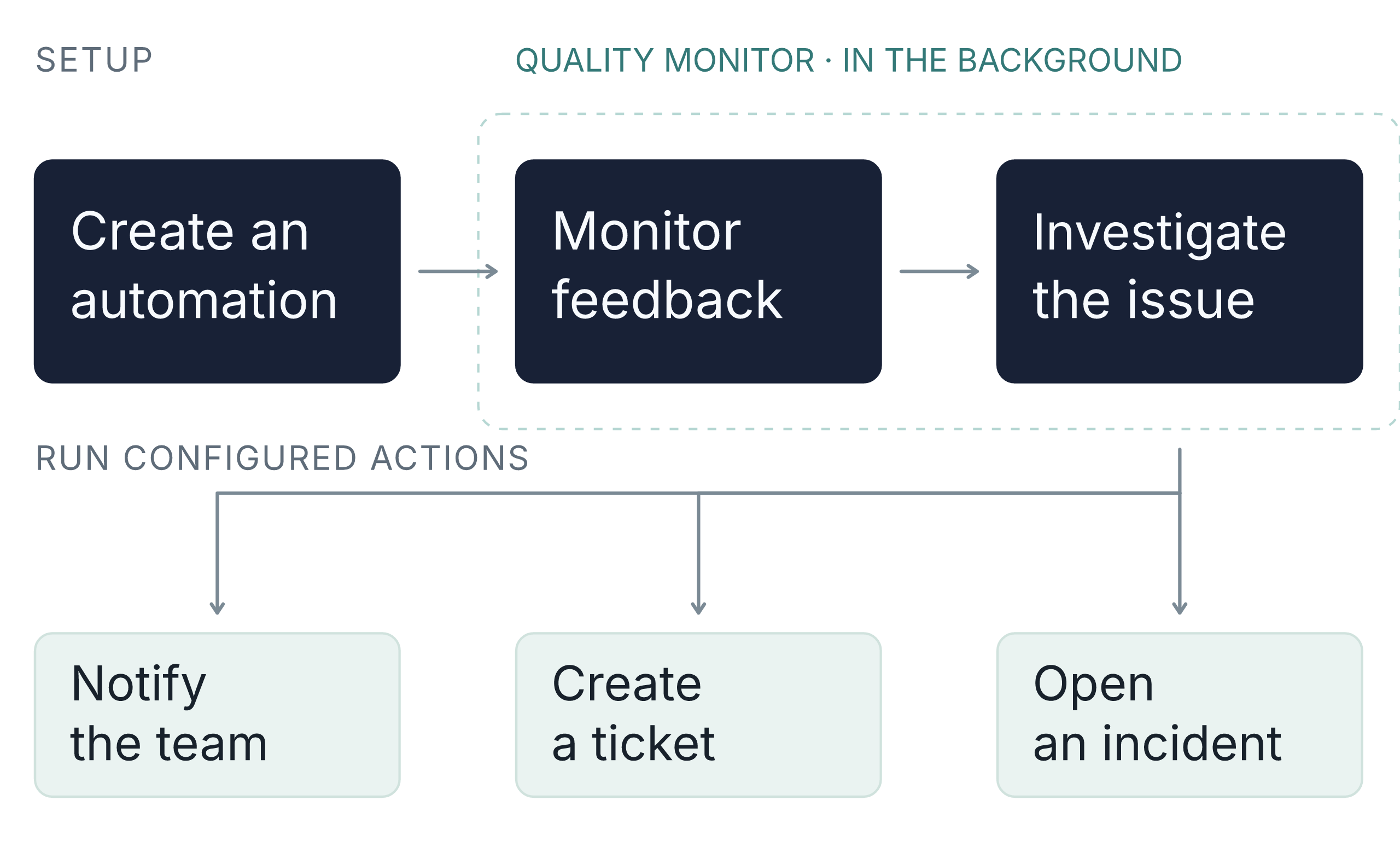
Quality Monitor helps teams spot those issues. A team creates an automation and chooses what it should watch. The monitor then works in the background, investigating feedback and alerting the team when it finds a potential issue.
My work focused on making those findings more useful and the workflow more reliable as usage grew. I also contributed to helping teams take action after an issue was found.
Learning to measure a good finding
One of the first questions I worked on was how to evaluate an alert. A finding might bring together feedback about different problems, or describe an issue in a way that goes beyond what the feedback supports.
I worked on evaluations that examined whether a signal was meaningful, whether its explanation reflected the feedback, and whether its title communicated the issue accurately. Breaking quality down this way gave us a more consistent way to assess findings and identify what needed improvement.
It also made me think about the person receiving the alert. Could they understand the issue, trust the context, and decide what to do next? Those questions helped me see that evaluating an agent means looking at how useful its output is, not just whether it produced an answer.
Making the workflow more reliable as usage grew
As more teams began using Quality Monitor, the infrastructure had to handle more work across customers. Detection, investigation, and delivery had different demands, so we needed a clearer way to manage them as the service grew.
I worked on moving the workflow toward an asynchronous architecture, separating responsibilities and passing work between stages. This gave us more flexibility to manage and scale each part according to its workload.
I also had to think about reliability: what happens if a stage cannot complete its work, and how can the workflow recover without losing progress? Separating the stages made it easier to identify where a problem occurred and which part of the system needed attention.
Like the transcription project, this brought system design concepts into focus for me. I could see how an architectural choice affected not just scale, but also how the team operated and improved the service.
From finding an issue to acting on it
An alert is often just the beginning. A team may still need to investigate, create a ticket, and involve the right people.
We saw an opportunity to make that next step easier. Quality Monitor already had context about the issue, so we could pass it into the tools where teams coordinate their response.
I contributed to extending the workflow through connectors. Depending on how an automation is configured, a finding can notify a team, create a Linear or Jira ticket, or open a PagerDuty incident with the relevant context.
That work helped me see the full journey more clearly: from identifying a meaningful issue to helping the right people act on it.
Working on these projects gave me the chance to learn by taking on real problems. But before any of that, my journey at Enterpret started with a series of conversations that gave both me and the team a chance to get to know each other.
How I got here
The internship interview process had four rounds: data structures and algorithms, low-level design, a technical interview, and a cultural conversation. Each explored a different side of how I approached problems and how I might work with the team.
The DSA and low-level design rounds focused on more than arriving at a solution. They gave me the chance to explain my reasoning, discuss alternatives, and respond to questions—much like the conversations I would later have while working through engineering problems with teammates.
The technical interview went deeper into projects I had built. We discussed how the systems worked, why I had made particular decisions, and what might need to change as requirements evolved. It was an early introduction to something I came to value at Enterpret: understanding and taking ownership of your work.
The cultural conversation explored the person behind those projects. Questions about what I would change in my past and how I wanted my life to look in the future made it a thoughtful conversation about experiences, priorities, and growth.
Throughout the process, HR helped me understand what to expect and how to prepare for each round. That guidance made the process feel approachable and helped me focus on the conversations themselves.
The people and the culture
The care that goes into hiring shows up in the people at Enterpret. There’s a high density of talent, and plenty to learn from the experience and knowledge across the team.
What makes that especially valuable is how approachable people are. Conversations feel comfortable, even when there’s a lot to learn. For an intern, being able to ask questions, admit a gap in understanding, and learn from experienced engineers makes a real difference. People are knowledgeable, humble, and down to earth.
The environment is relaxed, too. There’s a shared commitment to doing good work, alongside plenty of room to laugh, unwind, and enjoy each other’s company. “Work hard, party harder” captures that spirit well. Getting to know teammates beyond the work helps make the workplace feel welcoming.
Staying curious
When I joined Enterpret, most of what I knew about building systems came from college projects and reading about system design. During my internship, I learned what it takes to build for real customers: thinking about scale, handling production issues, and making decisions when things don’t go as expected.
The biggest lesson I’m taking with me is to stay curious. I didn’t need to have every answer from the start, but I did need to keep asking questions, exploring unfamiliar problems, and learning from the people around me.
I’m grateful to everyone at Enterpret who trusted me with responsibility and helped me grow. What started as an internship changed how I approach engineering—and reminded me that there’s always more to learn.

